Overview
In short, A laser beam projects an image of the page to be printed onto an electrically charged rotating drum coated with selenium, a special kind of element. Photoconductivity removes charge from the areas exposed to light. Dry ink (toner) particles are then electrostatically picked up by the drum's charged areas. The drum then prints the image onto paper by direct contact and heat, which fuses the ink to the paper.
In comparison with the laser printer, most inkjet printers and dot-matrix printers simply take an incoming stream of data and directly imprint it in a slow lurching process that may include pauses as the printer waits for more data. A laser printer is unable to work this way because such a large amount of data needs to output to the printing device in a rapid, continuous process. The printer cannot stop the mechanism precisely enough to wait until more data arrives, without creating a visible gap or misalignment of the dots on the printed page.
Instead the image data is built up and stored in a large bank of memory capable of representing every dot on the page. The requirement to store all dots in memory before printing has traditionally limited laser printers to small fixed paper sizes such as letter or A4. Most laser printers are unable to print continuous banners spanning a sheet of paper two meters long, because there is not enough memory available in the printer to store such a large image before printing begins.
Generating the raster image data
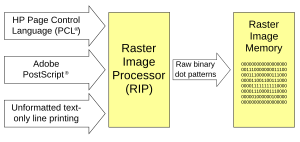
Each horizontal strip of dots across the page is known as a raster line or scan line. Creating the image to be printed is done by a Raster Image Processor (RIP), typically built into the laser printer. The source material may be encoded in any number of special page description languages such as Adobe PostScript (PS) , HP Printer Command Language (PCL), or Microsoft XML Page Specification (XPS) , as well as unformatted text-only data. The RIP uses the page description language to generate a bitmap of the final page in the raster memory. Once the entire page has been rendered in raster memory, the printer is ready to begin the process of sending the rasterized stream of dots to the paper in a continuous stream.
Wikipedia is great source for study on any kind of technical or non-technical stuffs. Wikipedia [books] are your best friends. Love the friendship to learn maximum of it :-)

No comments:
Post a Comment